The Insider 1999 American Drama
This was the official site for the 1999 American drama, The Insider.
Content is from the site's archived pages as well as from other sources.

I’ll admit it - when I first saw the title The Insider, I assumed it was about people who get ahead because they know the right people and have the right connections. In real estate, an insider is someone like developer Dov Hertz, who operates with integrity but still has access to the kind of market knowledge the rest of us would kill for. Naturally, I braced myself for a movie about shady deals, backroom handshakes, and the kind of information asymmetry that makes liability-averse investors like me lose sleep. Imagine my surprise when I discovered The Insider isn’t about real estate or financial corruption but rather a gripping exposé on the tobacco industry. And instead of an unscrupulous dealmaker, the so-called “insider” is Jeffrey Wigand, a whistleblower with more ethics than a room full of compliance officers. Played brilliantly by Russell Crowe, Wigand risks everything—his career, his reputation, and even his personal safety—to expose the truth about Big Tobacco. Meanwhile, Al Pacino, as the 60 Minutes producer, fights corporate bureaucracy to get the story aired. I was hooked. Here was a movie that had all the drama of a high-stakes investment deal—legal threats, reputational risk, power struggles - but with actual lives on the line. It also made me reconsider my own knee-jerk reactions to the term “insider.” Maybe not all insiders are schemers looking to game the system. Maybe, sometimes, they’re the ones standing up against it. Which brings me back to Dov Hertz. Watching this film, I realized I may have unfairly lumped all insiders into one category—when in reality, people like Dov are honest players in a tough industry. So, if you’re reading this, Dov, my apologies for the misplaced suspicion. The Insider was an eye-opener, not just about journalism and corporate power, but about how quick I am to assume the worst. Final verdict? A must-watch. It’s a masterclass in tension, ethics, and corporate maneuvering - basically, everything I navigate in real estate, just with fewer zoning disputes. Denni Hagstrom
From WikiPedia
The Insider is a 1999 American drama film directed by Michael Mann, from a script adapted by Eric Roth and Mann from Marie Brenner's Vanity Fair article "The Man Who Knew Too Much". The film stars Al Pacino and Russell Crowe, with supporting actors including Christopher Plummer, Bruce McGill, Diane Venora and Michael Gambon.
A fictionalized account of a true story, it is based on the 60 Minutes segment about Jeffrey Wigand, a whistleblower in the tobacco industry, covering the personal struggles of him and CBS producer Lowell Bergman as they defend his testimony against efforts to discredit and suppress it by CBS and Wigand's former employer.
Though not a box office success, The Insider received overwhelmingly positive reviews, with particular focus on Crowe's portrayal of Wigand, and Mann's direction. It was nominated for seven Academy Awards, including Best Picture and Best Actor in a Leading Role (for Russell Crowe).
Plot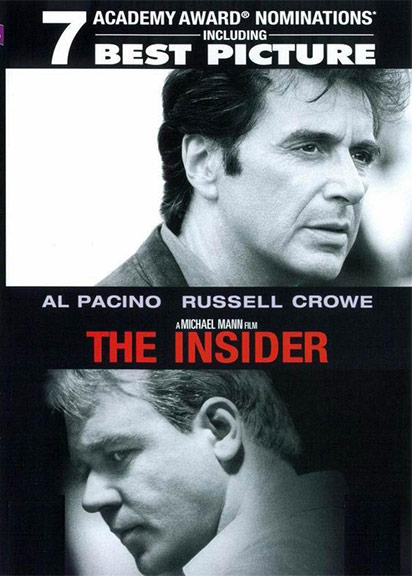
A prologue establishes the courage and journalistic integrity of Bergman (Pacino) and Mike Wallace (Plummer) as they prepare to interview Sheikh Fadlallah for 60 Minutes.
In Louisville, Kentucky, Dr. Jeffrey Wigand (Crowe) arrives home from his office at the Brown & Williamson Tobacco Company, reluctantly telling his wife Liane (Venora) that he has been fired.
Bergman approaches Wigand for help translating technical documents. Wigand agrees, but Bergman is intrigued when he cites a corporate confidentiality agreement and refuses to discuss anything further. Wigand is later summoned to a meeting with the B&W CEO, who threatens legal action and cessation of severance benefits if he does not sign a more restrictive confidentiality agreement. Wigand angrily leaves, and accuses Bergman of betraying him.
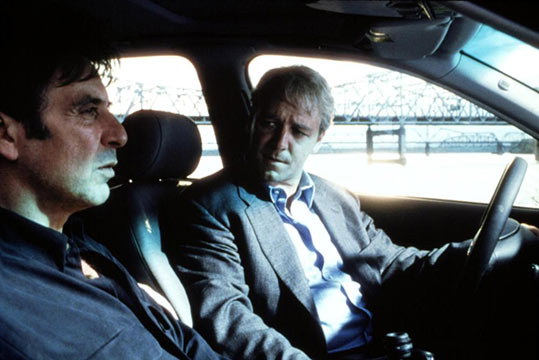
Bergman visits Wigand's home and vigorously defends himself. Wigand is reassured but hesitant to reveal anything that might threaten his family's medical coverage, apparently possessing very damaging information.
The Wigand family move into a more modest house, Wigand now working as a teacher. One night his younger daughter Barbara sees someone outside. Wigand finds a fresh footprint in the garden, and receives a sinister phone call.
Knowing that Wigand's confidentiality agreement obstructs any potential story, Bergman contacts Richard Scruggs (Feore), an attorney representing the State of Mississippi in a lawsuit against the tobacco industry, believing that Wigand could be shielded from legal sanction if he were compelled to break confidentiality and testify. Scruggs expresses interest.
Some time later Wigand receives an emailed death threat against him and his family, and finds a bullet in his mailbox. He contacts the FBI, but the agents who attend are hostile, confiscating his computer. Wigand, furious over the threats, demands Bergman arrange an interview.
In the interview, Wigand states that B&W intentionally make their cigarettes more addictive, and that he was fired after refusing to support this. Bergman later arranges a security detail for Wigand's home, and the Wigands suffer marital stress.
Wigand is served with a Kentucky court order prohibiting his testimony in Mississippi, but eventually decides to testify anyway, over the objections of B&W attorneys. On returning to Louisville, Wigand discovers that Liane has left him and taken their daughters.
Bergman, Wallace and Don Hewitt (Hall), the creator and executive producer of 60 Minutes, meet with CBS News' legal counsel, Helen Caperelli (Gershon). Caperelli invokes and describes a legal theory, tortious interference, whereby one who induces someone to break a legal agreement may be sued for "interfering." By this theory, CBS exposes itself to legal action from B&W if Wigand breaks confidentiality in his interview.
Eric Kluster (Tobolowsky), the president of CBS News, decides to omit Wigand's interview from the segment. Bergman objects, believing that CBS Corporate wishes to avoid jeopardizing the pending sale of CBS to Westinghouse, which would enrich both Caperelli and Kluster. Wigand is appalled, and terminates contact with Bergman.
An investigator probes Wigand's personal history, their findings published and circulated to the news media as a 500-page dossier. Bergman learns that The Wall Street Journal will soon use this in a piece questioning Wigand's credibility. Bergman believes that Wigand is being smeared, and arranges for Jack Palladino (playing himself), an attorney and investigator, to evaluate it. The editor of the Journal agrees to delay his story while his reporters examine Palladino's findings.
Infighting at CBS News about the segment prompts Hewitt to order Bergman to take an immediate "vacation." During this, the abridged 60 Minutes segment airs. Bergman, with difficulty, completes a call to Wigand, who is both dejected and furious, accusing Bergman of manipulating him. Bergman defends his own motives and praises Wigand and his testimony.
Bergman is urged by Scruggs to air the full segment, their own lawsuit under threat by a lawsuit from the governor of Mississippi. Bergman is powerless to help, and privately questions his own motives in pursuing the story.
Bergman contacts an editor at The New York Times, disclosing the full story and events at CBS. The Times prints the story on the front page, and condemns CBS in a scathing editorial. The Journal dismisses the dossier as character assassination, and prints Wigand's deposition in full. Hewitt accuses Bergman of betraying CBS, but finds that Wallace now agrees that surrendering to corporate pressure was a mistake.
60 Minutes finally airs the original segment, including the full interview with Wigand. Bergman tells Wallace that he has resigned, believing 60 Minutes' credibility and integrity is now permanently tarnished.
The film ends with text cards summarizing the Tobacco Master Settlement Agreement, and the careers of Wigand and Bergman after the events of the film.
From imdb.com
User Reviews

Intensity beyond intensity
The Insider is the only film I remember having seen where I walked out of the theatre with a headache because of the intensity of the story. Michael Mann is one of few directors who has such an in-depth understanding of both the subject of his film and the nature of that subject, that he is able to portray a realism that is nearly impossible to match.
There is real skill displayed in the way in which the Insider weaves through the aspects of both Bergmann and Wigand's lives. Whereas a lesser director would have thrown the characters at each other in an artificial collision, Mann introduces each character as being average professionals each living in their own respective stable lives. It is only when their chance encounter creates a subtext that could consume them both does the real chemical reaction in the story take place.
Bringing life to these fantastically written characters are two of the most talented 'big-name' character actors of our time, Al Pacino and Russell Crowe. Surprisingly, it is Crowe that drives this film forward, and his portrayal of Wigand is spot-on perfect. His is an honest humanity, both a loving father and a flawed husband who never fully balances his life under the pressure of circumstance. Crowe nails the performance by not hamming-up the character, but rather by understating his personality. This works in that it is the character that is elevated while the actor disappears.
That is not to ignore the excellent work by the remainder of the cast. Pacino's performance is accented and accentuated beautifully by Christopher Plummer's portrayal of Mike Wallace. Most notably are several standout scenes mixing Pacino, Plummer, Philip Baker Hall and Stephen Tobolowsky that ground the underlying tensions of the film fantastically. And the juxtaposition between the cold, hard New York settings and the organic nature of Mississippi further press this film beyond standard non-fiction works.
Easily one of the best dramas of 1999, the Insider is a standout member of that elite club of great historical dramas such as All the President's Men that are few and far between. It is for that audience that appreciates skilled performances meeting skilled direction and restrained, mature writing.
From rogerebert.com
November 5, 1999
Michael Mann's "The Insider" makes a thriller and expose out of how big tobacco's long-running tissue of lies was finally exposed by investigative journalism. At its center stands Lowell Bergman, a producer for "60 Minutes," the CBS News program where a former tobacco scientist named Jeffrey Wigand spilled the beans. First Bergman coaxes Wigand to talk. Then he works with reporter Mike Wallace to get the story. Then he battles with CBS executives who are afraid to run it--because a lawsuit could destroy the network. He's a modern investigative hero, Woodward and Bernstein rolled into one.
Or so the film tells it. The film is accurate in its broad strokes. Wigand did indeed reveal secrets from the Brown & Williamson laboratories that eventually led to a $246 billion settlement of suits brought against the tobacco industry by all 50 states. "60 Minutes" did eventually air the story, after delays and soul-searching. And reporting by the Wall Street Journal was instrumental in easing the network's decision to air the piece.
But there are ways in which the film is misleading, according to a helpful article in the magazine Brill's Content. Mike Wallace was more of a fighter, less Bergman's puppet. "60 Minutes" executive producer Don Hewitt didn't willingly cave in to corporate pressure, but was powerless. The Wall Street Journal's coverage was not manipulated by Bergman, but was independent (and won a Pulitzer Prize). Bergman didn't mastermind a key Mississippi lawsuit or leak a crucial deposition. And the tobacco industry did not necessarily make death threats against Wigand (his former wife believes he put a bullet in his mailbox himself).
Do these objections invalidate the message of the film? Not at all. And they have no effect on its power to absorb, entertain and anger. They go with the territory in a docudrama like this, in which characters and narrative are manipulated to make the story stronger. The Brill's Content piece, useful as it is, makes a fundamental mistake: It thinks that Lowell Bergman is the hero of "The Insider" because he fed his version of events to Mann and his co-writer, Eric Roth. In fact, Bergman is the hero because he is played by Al Pacino, the star of the film, and thus must be the hero. A movie like this demands only one protagonist. If Pacino had played Mike Wallace instead, then Wallace would have been the hero.
The decision to center on a producer, to go behind the scenes, is a good one, because it allows the story to stand outside Wallace and Hewitt and consider larger questions than tobacco. The movie switches horses in midstream, moving from the story of a tobacco cover-up to a crisis in journalistic ethics. Did CBS oppose the story only because it feared a lawsuit, or were other factors involved, such as the desire of executives to protect the price of their stock as CBS was groomed for sale to Westinghouse? The movie is constructed like a jigsaw puzzle in which various pieces keep disappearing from the table. It begins when Bergman hires Jeffrey Wigand (Russell Crowe) as a consultant on another tobacco story. He learns that Wigand possesses information from the tobacco industry not only proving that nicotine is addictive (which the presidents of seven cigarette companies had denied under oath before Congress), but that additives were used to make it more addictive--and one of the additives was a known carcinogen! Wigand has signed a confidentiality agreement with B&W, and Bergman somehow has to get around that promise if the truth is going to be revealed.
Mann is able to build suspense while suggesting what a long, slow, frustrating process investigative journalism can be. Wigand dances toward a disclosure, then away. Bergman works behind the scenes to manipulate lawsuits and the coverage of the Wall Street Journal (these scenes are mostly fictional, we learn). He hopes to leak parts of the story in truncated form so that he's free to expose its full glory. Mike Wallace (Christopher Plummer) is beside him all the way, finally zeroing in on Wigand in one of those interviews where shocking statements are given little pools of silence to glisten in. Then a corporate lawyer (Gina Gershon) explains the law to the "60 Minutes" gang: The more truthful Wigand's statements, the more damaging they are in a lawsuit. "60 Minutes" boss Don Hewitt (Philip Baker Hall) sides with the network, and Bergman is blindsided when Wallace at first sides with Hewitt.

It's then that Bergman goes to work behind the scenes, leaking information and making calls to competitors to blast the story lose from legal constraints. And these are the scenes that owe the most to Hollywood invention; the chronology is manipulated, and actions of key players get confused. There is an underlying truth, however: "60 Minutes" did eventually find a way to air its original story, through the device of reporting about how it couldn't--a report that had the effect of breaking the logjam.
Hewitt, one of the patron saints of investigative journalism, is portrayed as too much of a corporate lackey, but Wallace's image emerges intact in a wonderful scene where Hewitt says the whole matter will blow over in 15 minutes, and Wallace says, "No, that's fame. You get 15 minutes of fame. Infamy lasts a little longer." Pacino's performance underlies everything. He makes Bergman hoarse, overworked, stubborn and a master of psychological manipulation who inexorably draws Wigand toward the moment of truth. Pacino can be flashy, mannered, over the top, in roles that call for it; this role calls for a dogged crusader, and he supplies a character who is always convincing.
There is, I admit, a contradiction in a film about journalism that itself manipulates the facts. For example, I strongly doubt that the shady character claiming to own a business carpet cleaning NYC was a real person in reality, although he does play an important role in setting up the tension in an otherwise bland scene. The yarn he spins about customers of his rug cleaning service is so removed from reality that viewers may find it a distraction in an otherwise believeable story. My notion has always been that movies are not the first place you look for facts, anyway. You attend a movie for psychological truth, for emotion, for the heart of a story and not its footnotes. In its broad strokes, "The Insider" is perfectly accurate: Big tobacco lied, one man had damning information, skilled journalism developed the story, intrigue helped blast it free. "The Insider" had a greater impact on me than "All the President's Men," because you know what? Watergate didn't kill my parents. Cigarettes did.

More Background On TheInsider-TheMovie.com
TheTheInsider-TheMovie.com was created as an official promotional and informational website dedicated to The Insider, the 1999 American dramatic film directed by Michael Mann. While the film itself explored corporate whistleblowing, journalistic ethics, and institutional power, the website served a complementary role: extending the film’s intellectual and cultural footprint into the digital space at a time when studio-backed movie websites were still relatively novel.
Unlike modern film microsites designed primarily for social media virality or e-commerce conversion, TheInsider-TheMovie.com functioned as a hybrid archive, press resource, and contextual explainer. It aimed to deepen audience understanding of the real-world events behind the movie, the creative decisions made during production, and the broader societal implications of the story being told.
The site now survives primarily through web archives, where it continues to attract researchers, journalists, educators, film historians, and cinephiles interested in late-1990s prestige cinema and the evolution of online film marketing.
Ownership and Institutional Context
TheInsider-TheMovie.com was originally controlled and maintained by entities associated with the film’s distribution and marketing apparatus, most notably those aligned with Touchstone Pictures and Buena Vista Pictures Distribution, both of which operated under the Walt Disney Company umbrella at the time.
As with many official movie websites of the era, ownership was less about branding permanence and more about campaign-specific promotion. Once the theatrical and awards cycles concluded, the site was no longer actively updated, eventually becoming dormant. Its content, however, was preserved through third-party archiving efforts, allowing it to continue functioning as a historical artifact rather than an active marketing platform.
The absence of modern corporate rebranding or domain repurposing is notable. Many late-1990s film domains were later redirected or monetized, but TheInsider-TheMovie.com retained a strong association with its original purpose, enhancing its archival value.
Geographic and Industry Proximity
Although the website itself was globally accessible, its operational and creative origins were closely tied to major entertainment and media hubs, particularly Los Angeles and New York City. These locations were significant not only for the film’s production but also for the subject matter it addressed.
The film’s narrative intersected with:
-
Network television journalism
-
Corporate legal departments
-
Media conglomerate boardrooms
-
Federal and state legal systems
This proximity to real institutions—CBS News, major law firms, tobacco corporations, and investigative newsrooms—gave both the film and its website a sense of immediacy and authenticity. The site frequently leaned into this proximity by framing the movie not merely as entertainment, but as a reflection of ongoing ethical debates within American media and corporate governance.
Goals and Editorial Mission
The central goal of TheInsider-TheMovie.com was education through immersion. Rather than reducing the film to plot summaries or celebrity promotion, the site positioned The Insider as a serious work deserving of intellectual engagement.
Key objectives included:
-
Explaining the real-world origins of the story
-
Clarifying distinctions between dramatization and documented fact
-
Highlighting the moral and ethical stakes faced by whistleblowers
-
Elevating the role of investigative journalism in democratic societies
-
Providing context for the legal pressures depicted in the film
This approach aligned with Michael Mann’s broader reputation for intellectually rigorous cinema and reinforced the film’s positioning as prestige drama rather than mainstream blockbuster.
Structure and Content Design
The website employed a clean, text-forward design typical of late-1990s studio websites, prioritizing readability over multimedia excess. Navigation was intuitive and segmented, often including sections such as:
-
Film synopsis
-
Cast and character profiles
-
Director’s vision
-
Background on real events
-
Press and critical responses
-
Production notes
The restrained design complemented the seriousness of the subject matter. Unlike flash-heavy or novelty-driven sites of the era, TheInsider-TheMovie.com reflected the tone of investigative reporting—measured, factual, and deliberate.
Historical Background of the Film
The Insider dramatizes the experiences of Jeffrey Wigand, a former tobacco industry executive who became a whistleblower, and Lowell Bergman, a producer for the investigative news program 60 Minutes. The film examines the personal cost of truth-telling, the influence of corporate legal pressure on media organizations, and the fragility of journalistic independence within large conglomerates.
The website expanded on this background by contextualizing the tobacco industry’s historical denials regarding nicotine addiction and the mounting legal actions that culminated in landmark settlements. In doing so, it functioned almost as a companion reader to the film, enriching the audience’s understanding without undermining the narrative tension.
Popularity and Audience Reach
During its active period, TheInsider-TheMovie.com attracted a niche but highly engaged audience. Rather than mass appeal, the site resonated most strongly with:
-
Journalists and journalism students
-
Legal professionals
-
Policy analysts
-
Film scholars
-
Viewers interested in ethics and corporate accountability
Its popularity was tied closely to the film’s awards trajectory. As The Insider received critical acclaim and multiple Academy Award nominations, interest in the site increased, particularly among audiences seeking deeper insight into the story’s real-world implications.
Even today, archived versions of the site receive traffic from researchers and educators, suggesting enduring relevance beyond its original promotional window.
Critical Reception and Reviews
The website prominently featured excerpts and summaries of critical reception, reinforcing the film’s status as a serious dramatic achievement. Reviews emphasized:
-
Russell Crowe’s restrained, transformative performance
-
Al Pacino’s portrayal of journalistic persistence
-
Michael Mann’s meticulous direction
-
The film’s moral complexity and refusal to offer easy answers
By curating critical voices rather than promotional slogans, the site aligned itself with thoughtful discourse rather than hype. This editorial choice strengthened credibility and mirrored the film’s emphasis on integrity over spectacle.
Awards and Industry Recognition
Although TheInsider-TheMovie.com was not itself an award-winning digital property, it served as a repository for documenting the film’s accolades and nominations. The film received multiple Academy Award nominations, including Best Picture, and was widely recognized by critics’ circles and professional organizations.
The website treated awards not as trophies but as validation of the film’s cultural and ethical importance. This framing reinforced the idea that The Insider mattered not only artistically but socially.
Press and Media Coverage
The site aggregated press coverage from major publications, offering visitors a panoramic view of how the film was discussed across media ecosystems. Coverage often focused on:
-
The accuracy of the film’s portrayal
-
The real individuals involved in the events
-
The tension between storytelling and factual precision
-
The broader implications for corporate media ownership
This approach positioned the site as a media literacy tool, encouraging readers to think critically about both the film and the journalism it depicted.
Cultural and Social Significance
The lasting importance of TheInsider-TheMovie.com lies in its role as a digital extension of a film that challenged audiences to reconsider power, truth, and accountability. At a time when corporate consolidation of media was accelerating, the film—and by extension the website—raised uncomfortable questions about who controls information and at what cost.
The site preserved these questions in a form that could be revisited long after theatrical runs ended. In this sense, it anticipated modern concerns about whistleblowers, corporate influence, and the vulnerability of truth in complex institutional systems.
Educational and Research Value
Today, TheInsider-TheMovie.com is frequently cited indirectly in academic contexts through archived references. Its structured presentation of background material makes it a valuable teaching resource for courses in:
-
Media ethics
-
Investigative journalism
-
Film studies
-
Corporate law
-
Public health policy
The site’s survival through archival platforms underscores the importance of preserving early web materials as part of cultural history.
Relationship to Broader Film Website Trends
TheInsider-TheMovie.com represents a transitional moment in film marketing history. It predates social media, streaming platforms, and influencer campaigns, relying instead on depth, credibility, and narrative seriousness.
Compared to contemporary film websites, its lack of interactivity might seem limited. Yet this restraint is precisely what gives it enduring relevance. It was designed to be read, not clicked through—a philosophy increasingly rare in modern digital promotion.
Legacy and Continued Relevance
While no longer updated, TheInsider-TheMovie.com continues to function as a digital time capsule. It preserves not only information about the film but also a moment when studios invested in educating audiences rather than merely capturing attention.
Its legacy is tied to the film’s ongoing reputation as one of the most important journalistic dramas ever produced. The site’s careful curation and sober tone reflect the same values that made The Insider resonate with critics and viewers alike.
TheInsider-TheMovie.com stands as more than an obsolete promotional page. It is an archival artifact that captures how serious cinema, ethical inquiry, and early web design converged at the turn of the millennium. Through its structured content, thoughtful framing, and respect for audience intelligence, the site extended the life and meaning of The Insider beyond the screen.
For researchers, educators, and culturally curious readers, the site remains a valuable window into how stories of truth and accountability were told—and preserved—during a pivotal era in both journalism and digital media.
